
The Best AI Workout App in 2026: 10 Apps Compared
"AI workout app" covers very different things in 2026: algorithms that pick your exercises, programs that adjust to how you lifted last time, libraries of coach-written plans, chat coaches, and real coaches behind an app. This guide compares ten of them by what the AI actually does, what it costs in the US, and what each one misses.
Short answer: For hands-off gym sessions, Fitbod is the best-known AI workout app: it picks exercises and weights from your recovery and history. If you also want food tracking and a coach you can chat with, ego covers both on iPhone (we make it). Competitive powerlifters should look at JuggernautAI, people who want proven programs for free at Boostcamp, and anyone who wants a real person checking in at Future.
The 10 apps at a glance (November 2026)
| App | What the AI does | Tracks food | US price per year | Best for |
|---|---|---|---|---|
| ego (our app) | Builds the plan, suggests weights, chat coach | Yes | $49.99 (3-day trial) | Training and food from one coach |
| Fitbod | Picks exercises and weights from recovery | No | $95.99 | Hands-off gym sessions |
| JuggernautAI | Adjusts sets to daily readiness | No | $349.99 | Competitive powerlifting |
| Alpha Progression | Plan generator, per-set progression | No | $79.99 | Set-by-set progression for muscle gain |
| Boostcamp | Personalized programs, auto-progression (Pro) | No | Free, or $59.99 Pro | Proven coach programs |
| Hevy | Trainer builds a program (Pro) | No | Free, or $23.99 Pro | A cheap, social lifting log |
| MacroFactor Workouts | Generates a routine that adjusts with progress | In the separate MacroFactor app | $71.99, or $89.99 bundle | MacroFactor users |
| Zing | Adjusts to daily check-ins, camera form tracking | No | Up to $59.99 (see below) | Home workouts with form feedback |
| Ladder | None: coaches write team programs | Yes | $179.99 | Following a coach's program |
| Future | None: a human coach | No | $199 a month | A real person checking in |
What "AI" means in a workout app
The label hides five different products, and knowing which one you want narrows the list fast:
- Workout generators. An algorithm picks each session's exercises, sets and weights from your history, recovery and equipment. Fitbod, Alpha Progression and Zing work this way.
- Adaptive programs. You follow a structured program, and the load changes from how your last sets went or how ready you feel today. JuggernautAI, MacroFactor Workouts, Hevy Trainer and Boostcamp's auto-progression sit here.
- Program libraries. Coaches write the programs and the app helps you run them. Boostcamp's free library and Ladder's team programs are the main examples.
- Chat coaches. A language model you can ask questions, on top of a plan it can see. ego works this way.
- Human coaches in an app. A real person writes your program and checks in. That's Future.
How we compared these apps
We read each app's own pricing and feature pages and its US App Store listing on November 9, 2026. We didn't run a months-long training test of every app, so treat this as a feature and price comparison rather than a lab review. Each app was checked against five questions:
- What does the AI decide? Exercises, sets, weights, or only the next weight on a fixed program?
- What does it adapt to? Your logged sets, recovery, a daily check-in, or nothing?
- Can you talk to it? A chat coach, a human, or neither.
- Does it track food? Training and diet usually point at the same goal.
- What does it cost per year in the US, and what does the free tier include?
1. ego (our app): training and food from one coach
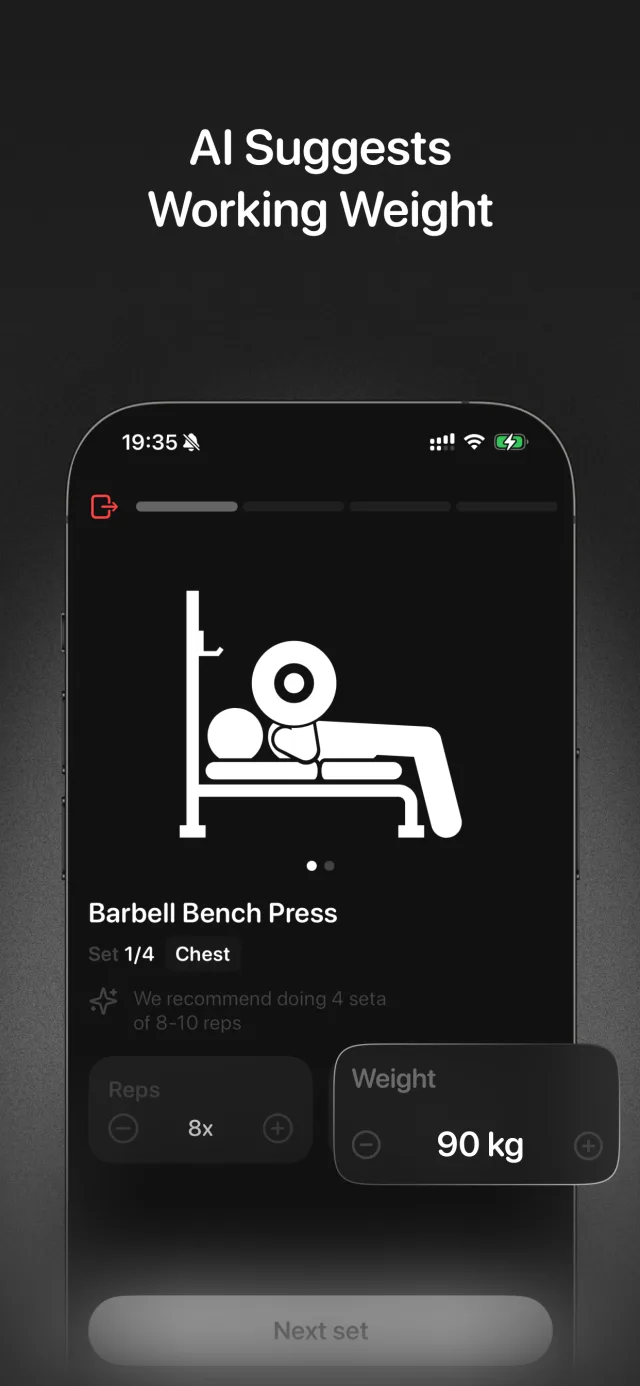
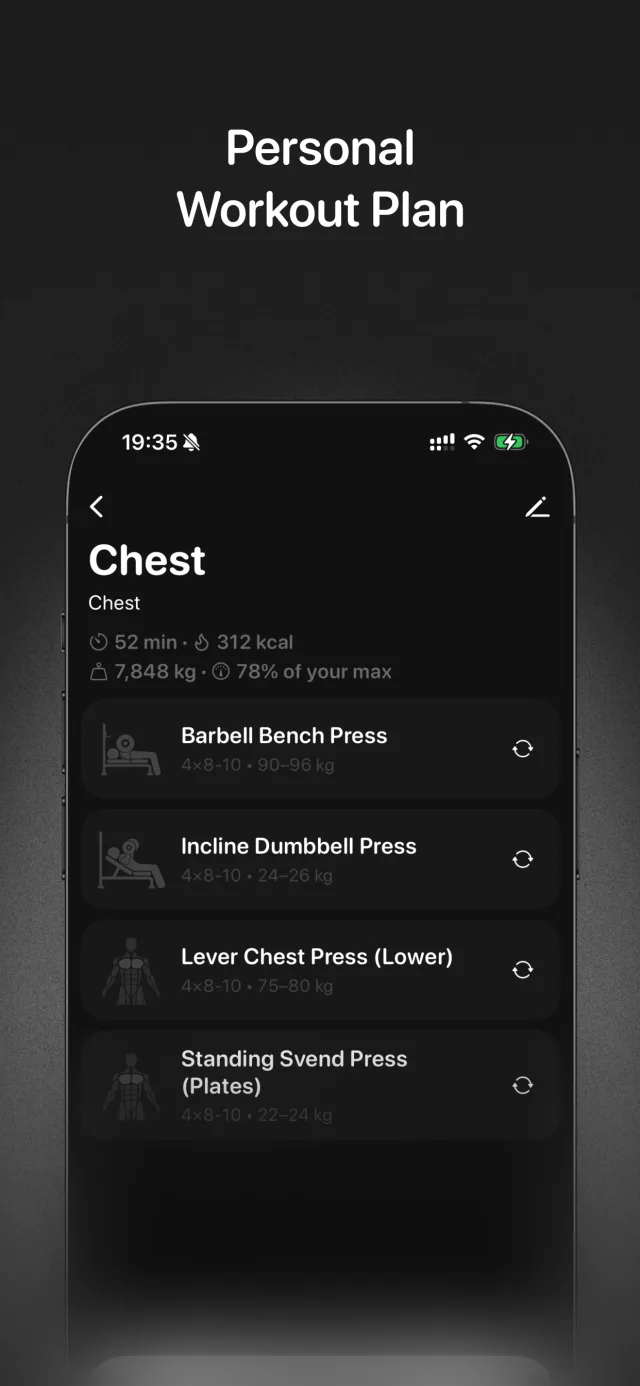
ego is an AI fitness coach for iPhone (iOS 18+). It builds a strength plan from your goal, experience, training days, equipment (full gym, home or bodyweight) and limitations, and suggests a working weight for each exercise that updates from the sets you log. A missed workout stays on your list for the week instead of forcing a restart, and on a morning after poor sleep the coach can offer a lighter version of the day's session (one set fewer on exercises with three or more, same weights), which you can take or skip.
The part most AI workout apps don't have is the chat. You can ask the coach why an exercise is in your plan or how your week went, and it answers with your plan, your recent logged workouts and the last 7 days of Apple Health steps, active calories and sleep in view. It can propose changes to your plan, which you accept or decline. You can swap an exercise for an alternative, import past training from a spreadsheet, and connect WHOOP, Oura or Garmin alongside Apple Health. The same app logs food by photo, barcode or chat, against calorie targets set from the same goal.
What it misses: iPhone only, with no Android or web app. It's a young app with few App Store ratings so far. There's no camera form tracking, and it doesn't plan around a powerlifting meet the way JuggernautAI does. The free account builds your plan and logs 1 workout; after that, logging needs a subscription.
Price: Full access is $49.99 a year after a 3-day free trial, or $6.99 a week. Details are on the pricing page.
2. Fitbod: best for hands-off gym sessions
Fitbod is the app AI assistants named most often in our tracking of ChatGPT, Claude, Gemini and Grok answers to this question. Its App Store listing promises "recovery and exercise tracking to AI-generated recommendations," says its "Adaptive AI learns from your edits to its workout recommendations," and uses non-linear periodization. It builds each session around the muscle groups that have recovered and the equipment you have, and sets the weights.
What it misses: no food tracking and no coach to talk to. Price: $15.99 a month or $95.99 a year; the US App Store also lists $12.99 monthly and $79.99 yearly plans. It runs on iPhone, Apple Watch and Android. If you're leaving it, see our Fitbod alternatives compared.
3. JuggernautAI: best for competitive powerlifting
JuggernautAI calls itself a "Personalized Powerlifting & Strength Training App." Before each session it checks in on your sleep, nutrition and other readiness factors, then makes set-by-set adjustments plus daily, weekly, block and program adjustments, with meet-day attempt planning.
What it misses: it's built for powerlifting, so it's more than most general lifters need, it doesn't log food, and it's the most expensive app here after a human coach. Price: $34.99 a month or $349.99 a year, with a 2-week free trial.
4. Alpha Progression: best for set-by-set progression
Pick your goals, equipment, training frequency and duration, and Alpha Progression's "plan generator builds you a science-backed program from 795 exercises," then gives a progression recommendation for each set. Split options include push pull legs, upper lower and full body.
What it misses: no food tracking or chat coach, and the generator and recommendations are Pro features. Price: $12.99 a month or $79.99 a year, with a 14-day free trial on the yearly plan. Building your own plans and logging are free.
5. Boostcamp: best for proven coach programs
Boostcamp's App Store listing describes a free workout tracker with "11,000+ programs" (nSuns and GZCLP among them) and "an AI coach that builds a custom plan from your goal, schedule, and equipment," plus auto-progression that "sets your next weights." Its own pricing page describes the same Pro feature as personalized programs "built from a questionnaire."
What it misses: no food tracking, and the personalized programs and auto-progression need Pro. Price: free, or Pro at $14.99 a month or $59.99 a year with a 7-day free trial.
6. Hevy: best for a cheap, social lifting log
Hevy is a popular workout logger with a free tier of up to 4 routines and 7 custom exercises. Hevy Trainer, part of Pro, "builds a program tailored to your experience, goal, available equipment, and preferences," per its App Store listing.
What it misses: no food tracking. Price: Pro is $2.99 a month, $23.99 a year or $74.99 once. More on our Hevy alternative page.
7. MacroFactor Workouts: best if you already use MacroFactor
The team behind the MacroFactor nutrition app sells training as a separate app. MacroFactor Workouts builds a "personalized strength-training routine based on your goals, fitness level, and equipment," and "your plan adjusts as you make progress."
What it misses: food lives in the other app, and neither has a free version. Price: $71.99 a year on its own, or $89.99 a year bundled with MacroFactor for people who started on or after January 1, 2026. iPhone and Android.
8. Zing: best for home workouts with form feedback
Zing's App Store listing says it "dynamically adjusts workout intensity and complexity based on your progress" and "checks in daily about your energy levels, mood, and sleep." Its Zing Vision feature uses the phone camera to track your movements and give form feedback.
What it misses: in an App Store reply, the developer says Zing "does not have a built-in calorie tracking feature." Price: the US App Store lists Premium at $18.99 and longer plans up to $59.99, without stating each plan's term. iPhone, Apple Watch and Android.
9. Ladder: best for following a coach's program
Ladder doesn't generate your workouts. You join a team, and a coach writes the weekly program, which you follow with in-ear coaching. Its App Store release notes show nutrition arriving in 2026, with a food library and a "smart log" for tracking macros.
What it misses: the program is written for the team, not generated for you, and there's no Android app. Price: Pro is $29.99 a month or $179.99 a year.
10. Future: when a human coach is better
Future isn't AI at all. A dedicated coach builds your program, and "your coach checks in, monitors your progress, and holds you accountable." It's the benchmark for what an AI app is trying to replace.
What it misses: price, mostly. Price: $50 for the first month, then $199 a month, with a full refund if you cancel within 30 days.
Others we looked at: Dr. Muscle updates your program after every set and adds automated recovery weeks on its paid plan. Gravl builds a plan, tells you how much to lift next time, and sells calorie tracking as a separate app, Gravl Macros.
Do AI workout apps actually work?
There is little independent research on specific apps, but studies of AI-written programs point the same way. A 2024 study in Biology of Sport asked GPT-3.5 and GPT-4 for 12-week resistance programs and concluded that ChatGPT "may serve as a complementary tool for writing 'draft' programme, but likely requires human expertise to maximise training programme effectiveness." In a second 2024 evaluation, exercise-prescription experts found GPT-4 programs "lacked precision in addressing individual health conditions and goals, often prioritizing excessive safety over the effectiveness of training."
Those studies tested one-off chat answers on older models. The case for a dedicated app is what happens after week one: it remembers every logged set, so the next weight comes from what you actually lifted rather than from a fresh guess. We go deeper on this in Is ChatGPT good at making workout plans?
How to pick
- You want the app to decide each gym session for you: Fitbod.
- You compete in powerlifting: JuggernautAI.
- You train for muscle and want per-set targets: Alpha Progression.
- You want a proven program and a free tier: Boostcamp or Hevy.
- You train at home and want form feedback: Zing.
- You want training and food in one app, with a coach you can ask questions (iPhone): ego.
- You want a real person and can afford it: Future.
Frequently asked questions
What is the best AI workout app?
Do AI personal trainer apps actually work?
Is there a free AI workout app?
Which AI workout app also tracks food?
Is an AI workout app better than a human coach?
An AI coach for the gym and the kitchen
Get a strength plan with suggested weights, log meals by photo, and ask the coach anything about your week. Download ego on the App Store and set your goal once.

Not ready to install? Try the free AI workout plan generator in your browser. No sign-up needed.