The Best App to Track Calories and Workouts Together (2026)
The search for the best app to track calories and workouts together usually ends with two subscriptions and a nightly ritual of copying numbers between them, because almost every serious app picks a side: it either counts your food or programs your training. This guide looks honestly at the real options in 2026 (MacroFactor, Fitbod, Hevy, and the two-app stacks most lifters settle for) and explains where ego, an AI coach that handles both sides in one app, fits in.
Short answer: There is no dominant all-in-one: MacroFactor is the strongest pure nutrition tracker, and Fitbod and Hevy are strong pure training apps, but each covers only half the job. If you want one app where the same AI sets your calorie targets and your training plan, with each side reacting to the other, ego (iPhone, iOS 18+) is built for exactly that. If you're on Android, or you want maximum depth in a single domain, a two-app stack is still the honest recommendation.
Why most apps only do half the job
Open the App Store and the split is obvious: the best nutrition apps treat training as an afterthought, and the best training apps ignore food entirely.
MacroFactor is arguably the sharpest macro tracker on the market, with adaptive calorie targets and a fast food logger, at $11.99 a month or $71.99 a year as of mid-2026. But the core app doesn't program workouts at all: the company sells training as a separate Workouts app with a paid bundle. Even the team that solved nutrition ships lifting as a second product.
Fitbod generates gym workouts from your equipment and recovery but has no food logging, and its price for new subscribers rose to about $16 a month (roughly $96 a year) in 2026. Hevy is a well-liked workout logger with a generous free tier, a cheap Pro plan around $24 a year, and zero nutrition features. MyFitnessPal has the giant food database, but its exercise side amounts to manual entry with no real programming behind it.
If you searched for an app that tracks workouts and calories, this is why every result seems to answer only half the question.
The two-app stack: real costs, real friction
The standard workaround is a stack: MacroFactor for food plus Fitbod or Hevy for lifting. It works, but count the cost. MacroFactor's annual plan ($71.99) plus Fitbod's ($95.99 for new subscribers) lands around $168 a year before you've paid for anything else.
The bigger problem is that the two apps never talk. Your nutrition app doesn't know you skipped three workouts this week, so your calorie target stays tuned for training you didn't do. Meanwhile the training app has no idea you've been eating 600 calories under target during a cut, and it keeps nudging your working weights up as if recovery were fine. Apple Health can pass raw numbers between them, but no app in the stack owns the whole picture. You are the integration layer, and doing that integration by hand every day is exactly the part most people quit.
What the best app to track calories and workouts together should do
Whether you pick one app or build a stack, hold any candidate for the best app to track macros and workouts together to the same checklist:
- One goal, two levers. Fat loss, muscle gain, or maintenance should drive both the training plan and the calorie and macro targets. You set it once and everything downstream follows.
- Targets that react to training. Daily calories and macros should update from what you actually did, rather than a static formula frozen on onboarding day.
- A plan that reacts to life. Missed sessions should reshuffle the program without breaking it or forcing a restart.
- Fast food logging. Photo, barcode, and plain-text entry. Logging friction is the main reason macro tracking dies by week three.
- Working weight guidance. The app should suggest what to lift for each exercise rather than passively recording whatever you type.
- Apple Health integration for steps, sleep, and active calories.
No two-app stack can check the first three boxes, because those require one brain over both datasets.
How ego covers both sides with one AI
ego is an AI fitness coach for iPhone (iOS 18+) built around exactly that gap: one AI that sees your training and your nutrition at the same time.
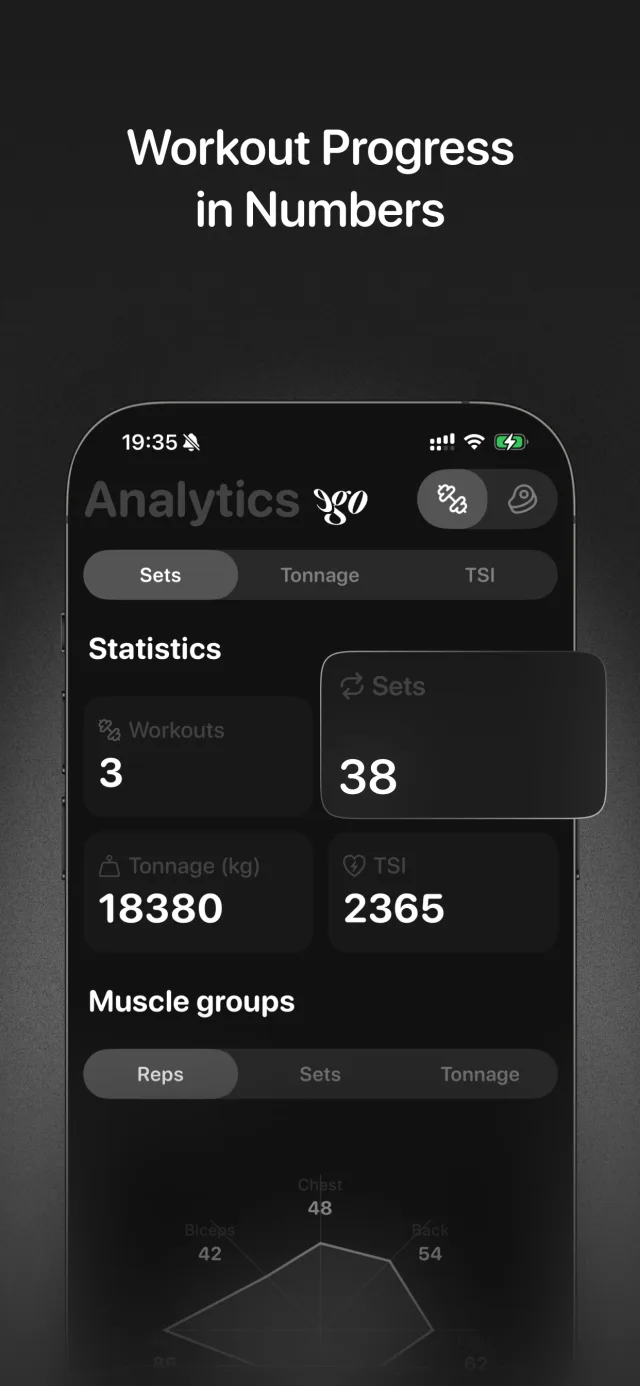
On the training side, it builds a personalized strength plan from your goal, experience, limitations, and activity level, and it adapts automatically when you miss workouts instead of making you restart. It also suggests a working weight for each exercise, which is the thing most people actually want when they search for the best app for progressive overload. We cover how the weight suggestions work separately.
On the nutrition side, you log meals by snapping a photo (calories and macros are estimated, and everything is editable), scanning a barcode for packaged food, or typing something like "chicken burrito and a coke" to the chat coach. Calorie and macro targets update daily, and a daily nutrition analysis calls out what's blocking your goal. If photo logging is your main interest, see our Cal AI alternative breakdown.
The honest trade-offs: ego is iPhone-only, it's free to download but needs a subscription for the full feature set, and a specialist app can still beat it on single-domain depth — MacroFactor's expenditure math and Hevy's social features are genuinely good. What ego offers is the thing no stack can: both halves of your progress inside one model.
How to track calories and workouts together with ego
- Download ego and set one goal
Get ego on the App Store (iPhone, iOS 18+). In onboarding, pick fat loss, muscle gain, or maintenance, then answer a few questions about your experience, limitations, and activity level. That single goal drives everything else.
- Let the AI build your plan and your targets
ego generates a personalized strength program plus daily calorie and macro targets from the same profile. There's no separate nutrition setup, so your food targets and training plan can never point at different goals.
- Log food the low-friction way
Snap a photo of your plate to get calories and macros (edit anything that looks off), scan barcodes on packaged food, or just type a meal into the chat with the Ego Agent. Pick whichever is fastest in the moment, since everything lands in the same log.
- Train with suggested working weights
Open the day's workout and ego suggests a working weight for each exercise, so progressive overload doesn't depend on memory or guesswork. Finished sessions are saved to Apple Health, and you get post-workout insights right after.
- Let both sides adapt on their own
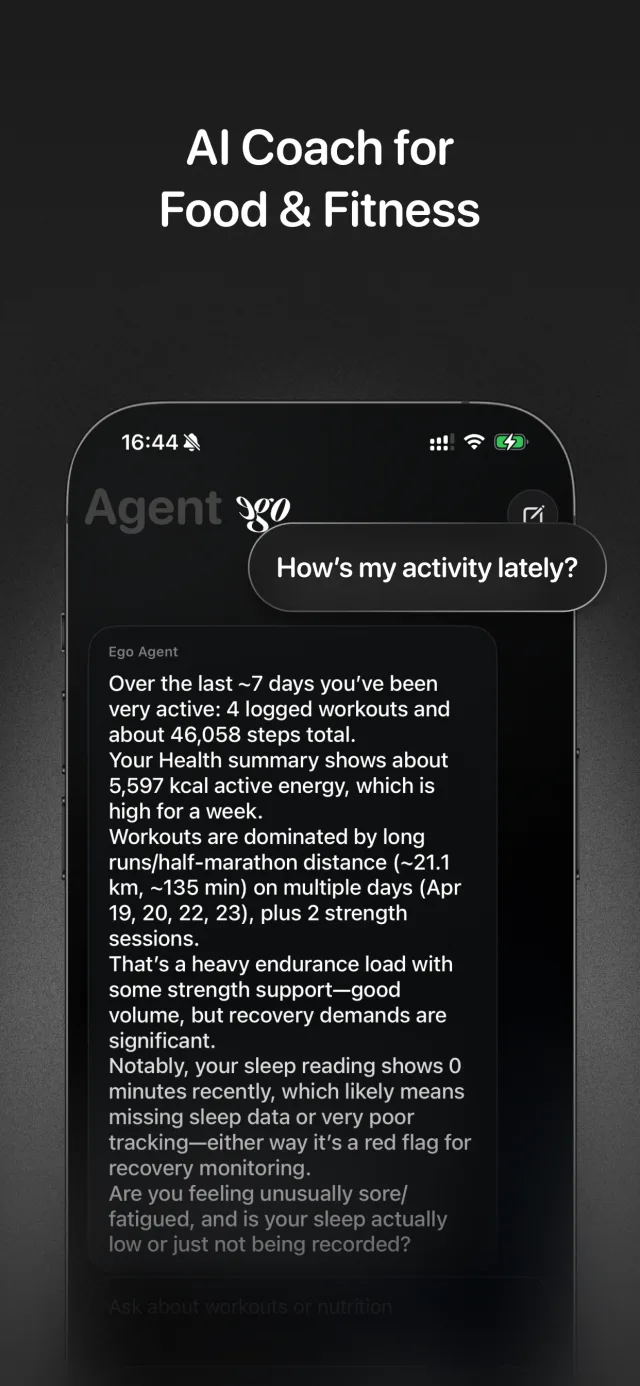
Miss a session and the plan reshuffles without a restart. Targets refresh daily, the Ego Agent reads your Apple Health steps, sleep, and active calories, and the daily nutrition analysis tells you specifically what's blocking your goal.
Frequently asked questions
Can one app really replace MacroFactor plus Fitbod or Hevy?
Does ego change my calorie targets based on my training?
Is there an Android version of ego?
Is one combined app cheaper than a two-app stack?
One coach for the gym and the kitchen
Stop being the middleman between your macro app and your workout log. Download ego on the App Store, set your goal once, and let one AI keep your training and your calories pointed at the same target.