Is ChatGPT Good at Making Workout Plans? What It Gets Wrong
Ask ChatGPT for a workout plan and you'll get one in about ten seconds: a tidy weekly split with exercises, sets, and reps. So is ChatGPT good at making workout plans, or just good at making things that look like workout plans? The honest answer is both. Here's what ChatGPT genuinely does well, where it breaks down after week one, and when an AI workout plan generator that actually tracks your training is worth paying for.

Short answer: ChatGPT is reasonably good at writing a first workout plan: for $0 it produces a sensible generic template, and research shows quality improves the more detail you give it. But it's stateless. It doesn't know what you actually lifted, can't adapt when you miss a session, can't suggest weights from your real performance, and doesn't track food or read your health data. Treat it as a starting template, not a coach.
What ChatGPT Gets Right About Workout Plans
ChatGPT has absorbed more training content than any human coach, and it shows. Ask for a four-day upper/lower split for fat loss and you'll usually get sensible exercise selection, workable rep ranges, rest days in reasonable places, and a short lecture on progressive overload. For someone who has never followed a structured program, that template is real value at zero cost.
Research supports the "decent, not great" read. A 2024 study in the Journal of Sports Science and Medicine had coaching experts score ChatGPT-generated training plans: none were rated optimal, but quality improved noticeably as the researchers gave the model more detail about the athlete. The authors still advised against following the plans without expert feedback.
How to prompt it well
- State your goal (fat loss, muscle gain, or maintenance), training experience, and how many days per week you can realistically train.
- List your equipment and any injuries or limitations.
- Ask it to explain why it picked each exercise so you can sanity-check the logic.
Is ChatGPT Good at Making Workout Plans That Last?
This is where the answer flips to no. The problems start the moment you close the chat, and every one of them traces back to the same root cause: ChatGPT is stateless, and coaching is a stateful job.
- It doesn't know what you lifted. Unless you type your entire session history back in every time, week 4 is planned with the same information as week 1.
- It can't react to a missed session. Skip Wednesday and the plan doesn't know. You either skip the work entirely or ask it to reshuffle, again, by hand.
- It can't prescribe loads. "Choose a challenging weight" is not programming. Without your actual set-by-set data, it has nothing to base a number on.
- It can't see your body's data. No connection to Apple Health means no awareness of your steps, sleep, or logged workouts.
- It doesn't track anything. Even a perfect plan leaves you managing a spreadsheet or a second app for logging.
ChatGPT's memory feature softens this only slightly. It stores loose facts like "user trains four days a week," not a structured training log it can compute progression from.
ChatGPT Workout Plan vs AI Fitness App
An AI fitness app uses the same core idea, a language model planning your training, but wraps it in state: a saved profile, a live training history, and a connection to your phone's health data. That difference is the whole product. With ego, you answer the goal, experience, and limitation questions once, and the plan they produce stays alive afterward.
- When you miss a workout, the plan restructures automatically instead of forcing a restart.
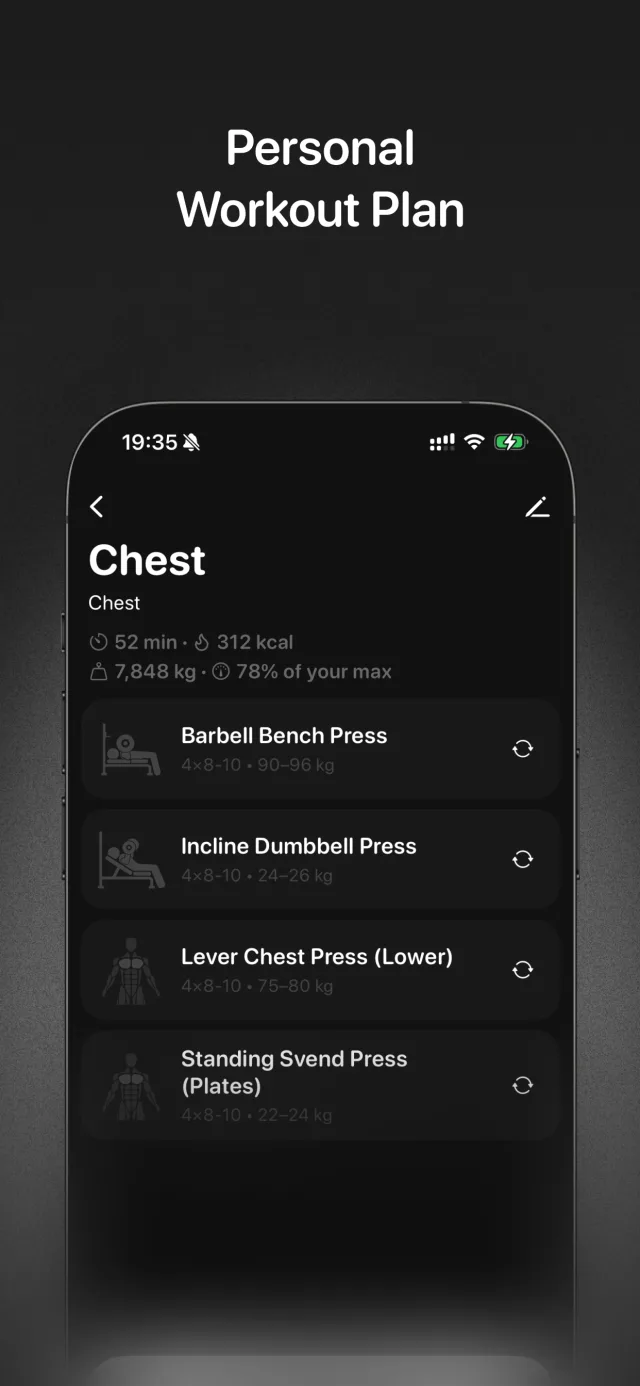
- It suggests working weights per exercise instead of telling you to pick something challenging.
- It reads your Apple Health steps, sleep, active calories, and workouts, and saves finished workouts back to Apple Health.
- Training and nutrition tracking live in the same app, so insights draw on both.
The honest trade-off: ChatGPT's free tier costs nothing forever, while ego is free to download but needs a subscription to unlock personalized plan generation, smart nutrition tracking, and personal analytics. If all you want is a one-off template you'll manage in a notebook, ChatGPT is enough. If you want the plan to keep up with your actual life, you need software with memory.
Can ChatGPT Count Calories From a Photo?
Sort of. ChatGPT can look at a food photo and produce a rough calorie estimate, and for simple, visible foods it's often in a usable range. But it's a one-off guess in a chat window: portion sizes are guesswork unless you describe them, there's no barcode lookup for packaged food, and the number goes nowhere. No food log, no running daily total, no target to measure against.
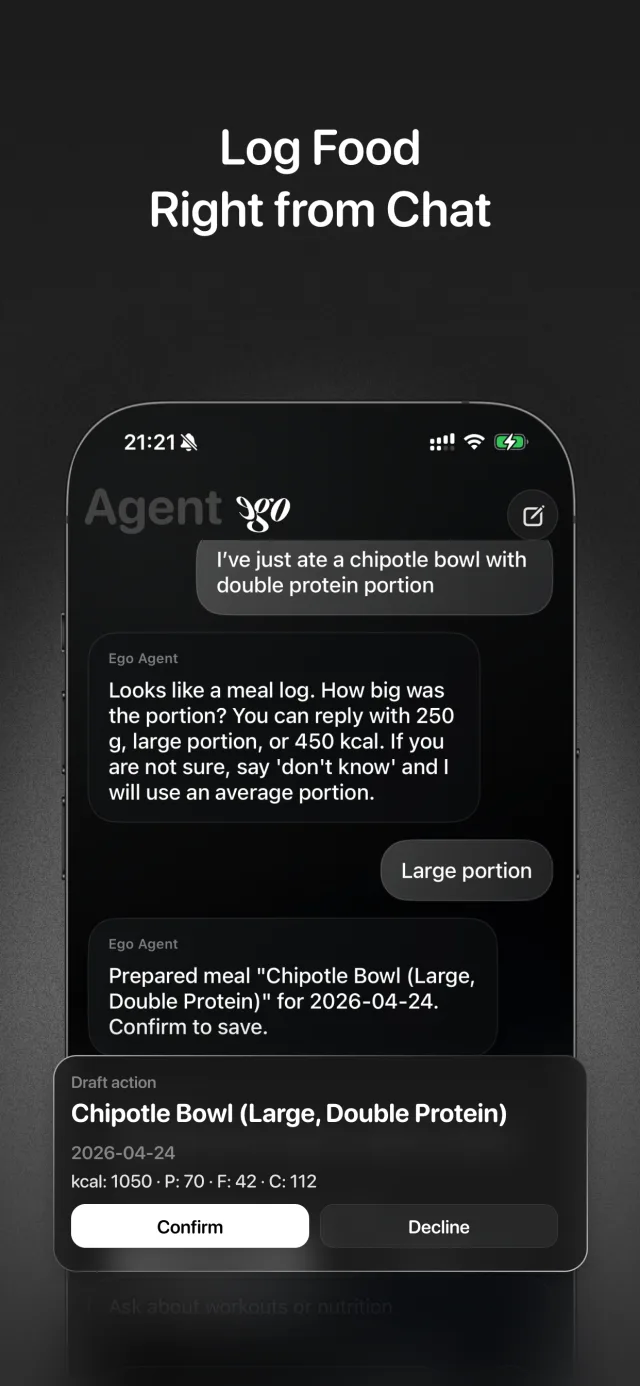
ego treats the photo as the input to an actual tracking system: snap a meal, get calories and macros you can edit, scan barcodes on packaged food, and watch it all count against calorie and macro targets that update daily. You can also log meals by typing to the AI coach in chat, which covers the "I'm already mid-conversation" habit ChatGPT users have, except the meal actually gets recorded. A daily nutrition analysis then tells you what's blocking your goal, which a stateless chat can never do because it never saw yesterday.
How to Get an Adaptive AI Workout Plan With ego
- Download ego on your iPhone
ego: AI Fitness Coach is free to download on the App Store and runs on iPhone with iOS 18 or later. The full feature set unlocks with a subscription.
- Answer the questions you'd normally type into ChatGPT
Goal (fat loss, muscle gain, or maintenance), experience, limitations, and activity level. Same inputs, one key difference: they're saved as your profile, so you never re-explain yourself.
- Start with suggested working weights
The AI suggests a working weight for each exercise, so session one starts with numbers instead of "pick something challenging."
- Miss a session and let the plan restructure
When life interrupts, the plan adapts automatically. No restarting week 1, no manual reshuffling in a chat window.
- Log food by photo, barcode, or chat
Snap a meal for calories and macros, scan barcodes for packaged food, or tell the Ego Agent what you ate in plain text. Everything counts toward daily-updated targets.
- Read your insights
After workouts you get post-workout insights, and the daily nutrition analysis flags what's blocking your goal, based on data ChatGPT never has.
Frequently asked questions
Can ChatGPT adjust my workout plan when I miss a session?
Does ChatGPT remember my workouts between conversations?
Can I paste a ChatGPT workout plan into a tracking app?
Is a ChatGPT workout plan safe for beginners?
Stop re-explaining yourself to a chatbot
ego builds your plan once, then keeps it current: adapting when you miss sessions, suggesting weights per exercise, and tracking meals from a photo. Free to download on the App Store for iPhone.