Workout Apps That Actually Adjust to Your Sleep and Recovery
If you're searching for a workout app that adjusts based on sleep and recovery, you've probably lived the alternative: a program that prescribes heavy squats on five hours of sleep because it has no idea you didn't sleep. This guide covers why recovery-blind programs quietly fail, which signals actually matter, an honest look at what popular apps do and don't read, and how ego uses your Apple Health data to coach around your real daily state.
Short answer: most strength training apps don't adjust to sleep at all. Fitbod, the best-known adaptive lifting app, models per-muscle fatigue from your logged workouts, and sleep never enters that math. Wearables like Whoop and Garmin measure recovery well but require their hardware and stop at a score. ego takes a different approach on iPhone: its AI coach reads your Apple Health sleep, steps, active calories, and workouts, and factors that daily state into its coaching, working-weight suggestions, and insights.
Why recovery-blind programs fail
A static program prescribes Tuesday's squat session whether you slept nine hours or five. That gap costs more than it seems. A 2022 meta-analysis in Sports Medicine found acute sleep loss reduced next-day exercise performance by an average of about 7.6%, with significant effects across every exercise category examined. A 2025 meta-analysis in Frontiers in Physiology likewise found sleep deprivation significantly impaired maximum force output.
Here's how that plays out in a real week. You sleep five hours, show up anyway, and grind through weights that were set for a rested version of you. Bar speed drops and reps get ugly. You either miss lifts or pile up fatigue that bleeds into the next session. A recovery-blind app then reads the missed reps as weakness and adjusts in the wrong direction, when the real problem was a program that never saw how little you slept.
What a workout app that adjusts based on sleep and recovery should read
You don't need an exotic readiness algorithm. A workout app that adjusts based on sleep and recovery needs a handful of signals your iPhone already collects in Apple Health:
- Sleep duration. The single clearest recovery signal. Last night versus your normal matters more than any composite score.
- Steps. Context for life outside the gym. A 4,000-step desk day and an 18,000-step day on your feet demand different training loads.
- Active calories. Total energy output beyond your logged lifts: the hike, the bike commute, the pickup game your program never knew about.
- Logged workouts. Accumulated training load, including cardio sessions recorded by other apps or a watch.
The bar to clear is simple: the app should be able to answer "should I train hard today?" from your actual numbers. Most apps can't, because they never read the data.
The honest market check: most training apps ignore your sleep
Worth knowing before you pay for anything:
- Fitbod assigns each muscle group a freshness percentage based on the training you log, and synced Apple Health activity can feed that model. But per Fitbod's own documentation, its recovery math is built on logged workouts, and sleep plays no part in it. If you slept four hours but your chest is "fresh," you still get heavy bench.
- Whoop and Garmin genuinely measure sleep and compute recovery or readiness scores, but both require their hardware, and a score still leaves you translating "recovery: 54%" into sets and reps on your own.
- ChatGPT-style plans are static text. They can't see your sleep, your steps, or whether you even did last week's workouts, a trade-off we break down in our guide to using ChatGPT for workout plans.
None of these are bad tools. They just leave the recovery-to-training translation to you, which is exactly the job you wanted the app to do.
How ego factors sleep and daily state into coaching
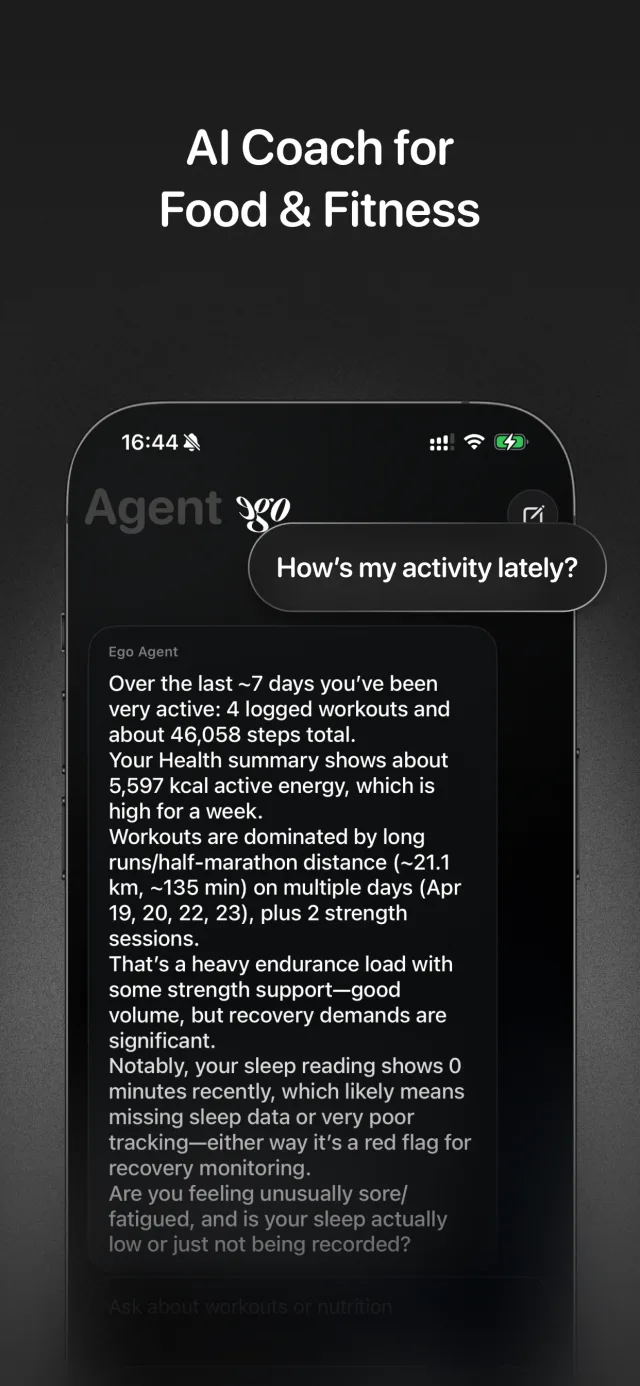
ego is an AI fitness coach for iPhone (iOS 18+) that connects the two halves other apps keep separate: your Apple Health data and your actual training plan. With your permission, the AI coach reads your sleep, steps, active calories, and workouts from Apple Health, and it saves your finished lifts back to it.
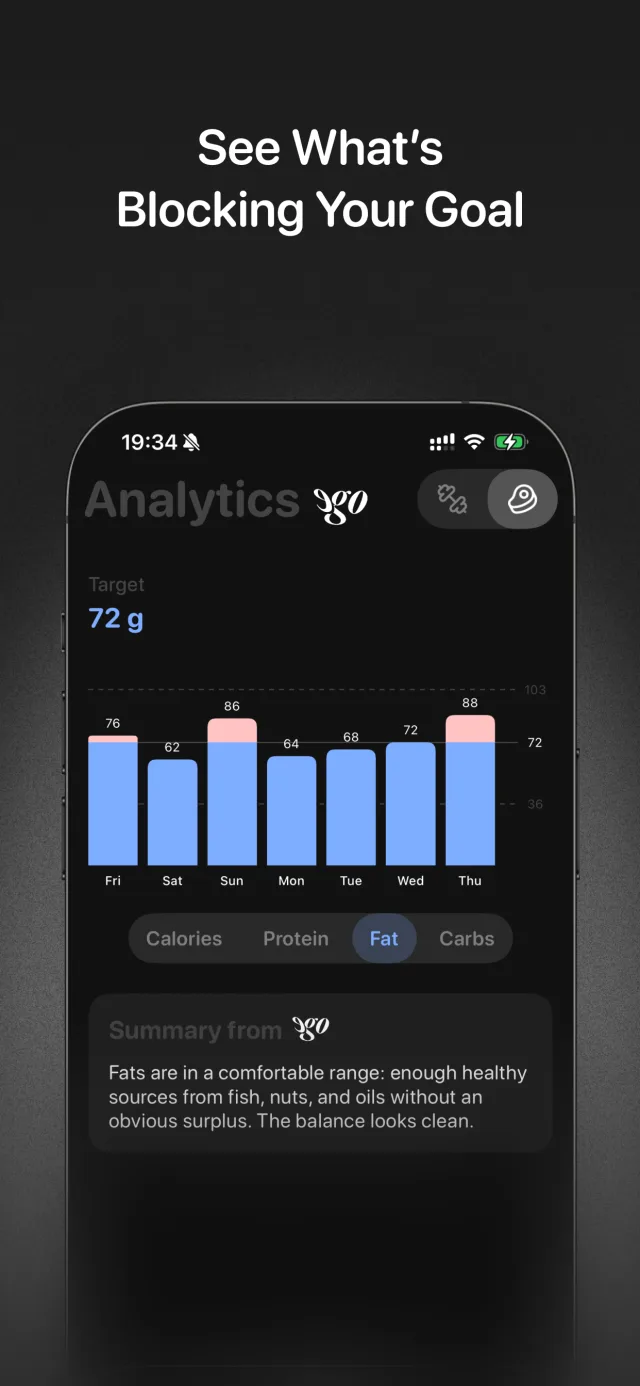
That changes what coaching looks like in practice. Ask the chat coach "I slept five hours, should I still do legs?" and it answers from your real numbers rather than a canned motivational reply. The AI suggests working weights per exercise, gives post-workout insights, and runs a daily nutrition analysis that flags what's blocking your goal, including patterns like consistently short sleep or under-eating on training days. Sleep is only one part of recovery, which is why tracking calories and workouts together in one app matters.
And when life wins and you skip a session, the plan adapts automatically instead of making you start the program over. We cover that mechanic in detail in our guide to workout apps that adjust when you miss a workout.
Straight talk on cost: ego is free to download, and a subscription unlocks the full feature set: personalized workout generation, smart nutrition tracking, and personal analytics. It's iPhone-only; there's no Android version.
How to set up sleep-aware training with ego
- Download ego and build your plan
Get ego on the App Store (iPhone, iOS 18+). Onboarding asks for your goal (fat loss, muscle gain, or maintenance), experience, limitations, and activity level, then the AI builds a personalized strength plan around them.
- Connect Apple Health
Grant ego read access to sleep, steps, active calories, and workouts. This is the step that separates a sleep-aware coach from a static PDF. Without that access, no app can adjust to your recovery.
- Check in with the coach on rough mornings
Slept badly? Ask the chat coach directly: "I got five hours, should I still train?" It reads your Apple Health data and answers from what your night and recent activity actually looked like.
- Use the suggested working weights
ego suggests a working weight for each exercise. On a run-down day, talk it through with the coach instead of grinding prescribed numbers set for a rested you.
- Don't restart when you miss a session
Skip a workout and the plan adapts automatically. You never repeat week one because life happened in week three.
- Read your daily insights
Post-workout insights and the daily nutrition analysis surface what's actually blocking your goal, whether that's short sleep, low protein, or too little activity between sessions, so you can work on the cause instead of the symptom.
Frequently asked questions
Does ego actually read sleep data from Apple Health?
Do I need an Apple Watch for ego to see my sleep?
Does Fitbod adjust workouts based on sleep?
How much does one bad night of sleep hurt a workout?
Train with a coach that can actually see your sleep
ego is free to download on iPhone (iOS 18+). Connect Apple Health and the AI coach factors your sleep, steps, and active calories into every answer it gives you, with no wearable subscription and no score to decode on your own.